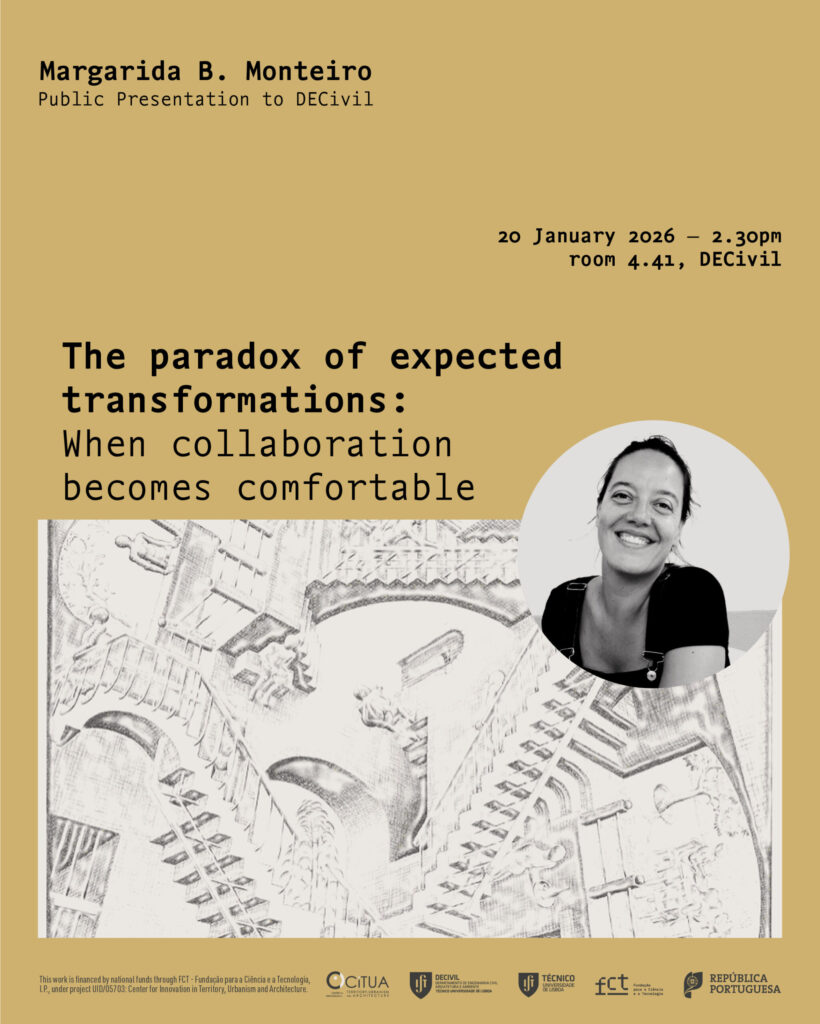
MARGARIDA BARATA MONTEIRO
The Paradox of Expected Transformations: When Collaboration Becomes Comfortable
PUBLIC PRESENTATION TO DECIVIL
20 January 2026, 14h30 – 15h30, Civil Engineering Building, IST (room 4.41)
Synopsis of CV: Margarida B. Monteiro obtained her M.Sc. in Environmental Engineering at Instituto Superior Técnico (IST) in 2011. Holds a Ph.D. in Environmental Engineering from IST with specialisation in strategic and sustainability assessment and governance. Margarida also holds a postgraduation in Sociology of Organisations fom the New University of Lisbon. She was, between 2019-2022, part of the board member of the Portuguese Association for Impact Assessment (APAI). Margarida is an integrated member of the Center for Innovation in Territory, Urbanism, and Architecture (CiTUA), and an assistant professor at the Civil Engineering Department of IST. Since the beginning of her scientific career, Margarida has integrated research teams of several national and international research projects (funded by FCT, FP7, INTERREG-MED, ERASMUS+, HORIZON 2020, HORIZON EUROPE, BIODIVERSA+) on the fields of strategic and sustainability assessment, transformative change, social innovation, participatory approaches, and collaborative governance. She is co-author of 11 papers in international peer-reviewed journals, +50 communications in national and international conferences, and 1 book chapter.
Summary of the Seminar: Collaborative governance has become a central expectation of contemporary European territorial and urban policy, promoted as a key mechanism for triggering sustainability transformations. Integration, multi-actor collaboration, experimentation and continuous evaluation increasingly shape planning, engineering and environmental practice. Yet, despite the widespread institutionalisation of these approaches, transformative outcomes often remain limited or uneven. This seminar examin es this paradox by analysing how collaborative governance can become highly institutionalised while remaining weakly transformative. Rather than rejecting collaboration, it reframes it as an object of critical inquiry, discussing the conditions under which collaborative processes contribute to territorial transformations and highlighting dynamics of proceduralisation, decoupling between processes and outcomes, and weak scaling of pilot initiatives.